From Children to Companions: Japan’s Shichi-Go-San Festival Embraces the 'Fur-Baby' Trend
### A New Tradition at the Shrine
In the serene courtyard of the Ichigaya Kameoka Hachiman-gu Shrine in Tokyo, the air is filled with a blend of solemnity and whimsical charm. A Shinto priest, clad in traditional robes, rhythmically waves a *haraegushi*—a purification wand adorned with white paper streamers—while chanting sacred prayers. However, the recipients of these blessings are not the usual young children, but a colorful array of pets, including a poised cat, a Shiba Inu, and several spirited Yorkshire Terriers.
This scene takes place during the period surrounding *Shichi-Go-San*, a centuries-old Japanese tradition celebrated annually on November 15. Traditionally, the festival is a rite of passage for children reaching the ages of three, five, and seven, marking their healthy growth and praying for their future well-being. Yet, in a poignant reflection of Japan's current demographic reality, the shrine's visitors are increasingly bringing their 'fur-babies' to partake in the festivities.
### Tailored Love and Tiny Kimonos
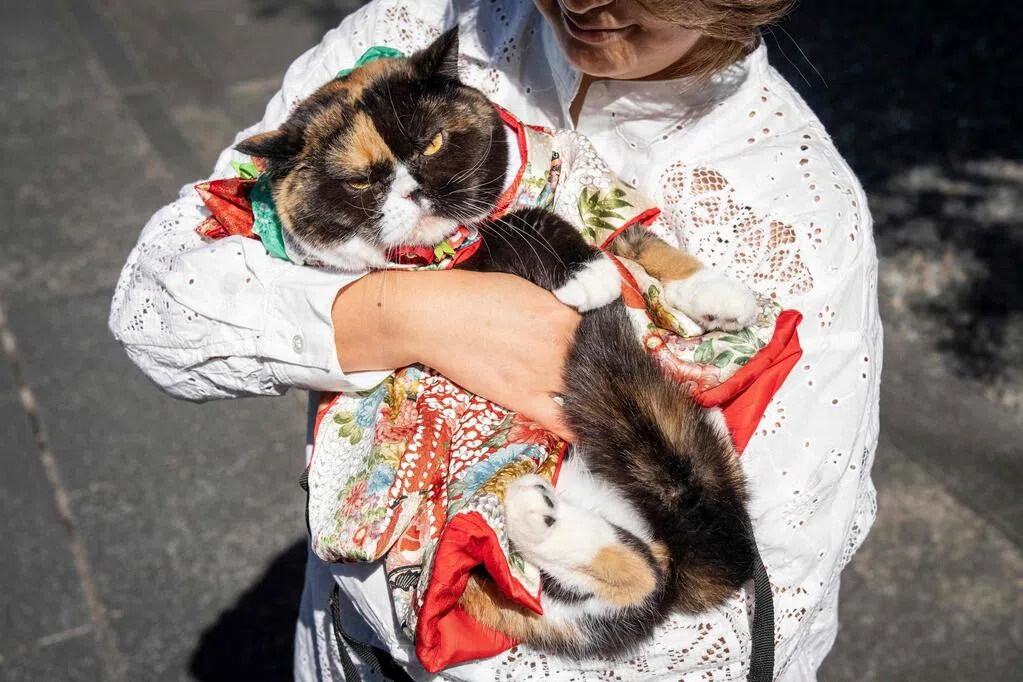
For many owners, these pets are far more than animals; they are the emotional center of the household. Shoko Kodama, a 46-year-old physician, spent two months meticulously sewing a vibrant red kimono for her five-year-old British Shorthair cat, Amber. For Kodama, the effort was a labor of love. She describes Amber as being akin to her own child, noting that the cat's presence has the power to dissolve the stresses and unpleasantries of daily life.
Outside the shrine, the scene is a kaleidoscope of colors. Pets of various breeds are dressed in miniature, ornate kimonos, posing for photographs to commemorate the day. For 23-year-old Miyu Shiro, who brought her two Yorkshire Terriers adorned with flower-shaped hair clips, the experience feels entirely natural. To her, the dogs are an integral part of the family unit.
Similarly, 57-year-old Koichi Ohara, who visited with his wife and friends, brought along three Chihuahuas. Despite having three human children of his own, Ohara expressed a special fondness for his dogs, praising their 'unconditional love' and their tendency to be more affectionate than human children. His wish for them is simple: a long, healthy, and peaceful life.
### A Mirror of Demographic Crisis
This shift in the Shichi-Go-San tradition is not merely a quirky trend but a symptom of a deeper systemic crisis. Japan is currently facing a dual challenge of an aging population and a plummeting birthrate. According to data released in June, the nation's fertility rate has once again hit a historic low, signaling a demographic contraction that threatens the stability of the world's fourth-largest economy.
World Bank statistics underscore the severity of the situation, placing Japan's median age at 49.9 years—making it the second-oldest society globally, surpassed only by Monaco. As the number of children declines, the role of pets has undergone a fundamental transformation. They are no longer just companions but have stepped into the role of children for those who are childless or whose children have long since left the nest.
### Adapting Ancient Rites to Modern Realities
Kenji Kaji, the priest at the Ichigaya Kameoka Hachiman-gu Shrine, has witnessed this evolution firsthand. Since the early 2000s, the shrine has expanded its services to accommodate the growing demand from pet owners. During the festive season, Kaji now welcomes approximately 400 families who bring their pets for purification rituals.
Kaji observes that as family structures shift, the spiritual needs of the people shift as well. He recognizes that for many, the act of bringing a dog or cat to the shrine is a way to express love and ensure the safety of a being that provides them with immense emotional support. In a society where the traditional family unit is shrinking, the sanctuary of the shrine has adapted, offering a space where the bond between humans and their animals can be formally celebrated and blessed.