Seoul Navigates Geopolitical Risks with Trial Voyage Through Arctic Waters
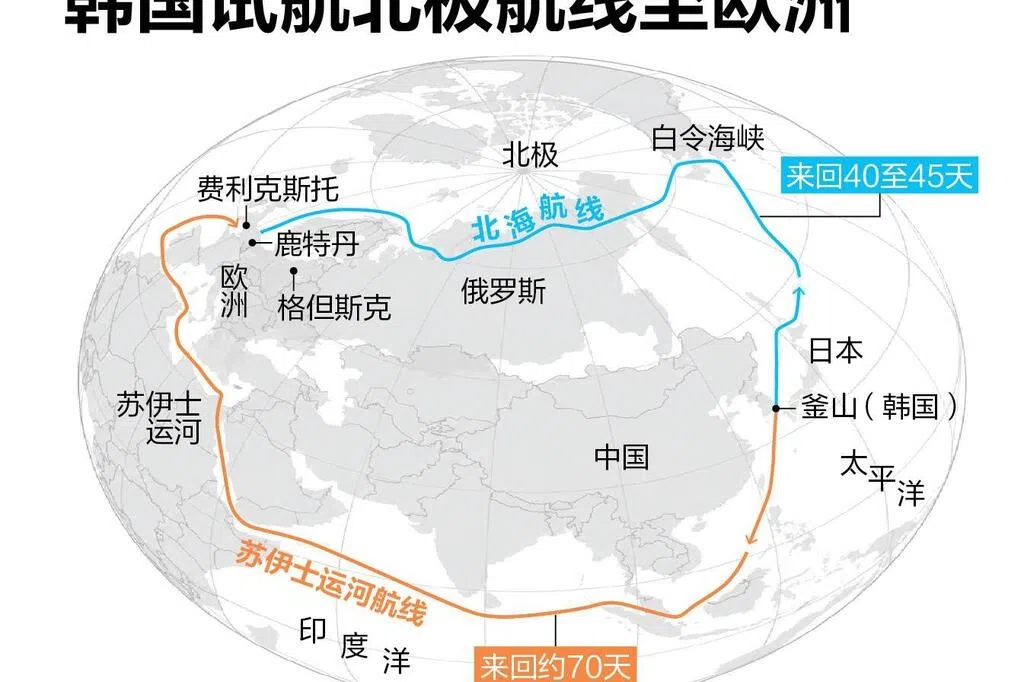
In a strategic move to insulate its trade networks from the ongoing volatility of Middle East shipping lanes, South Korea is preparing to launch its first commercial trial of the Northern Sea Route (NSR). The voyage, scheduled to commence this weekend, represents a calculated attempt by Seoul to determine if the Arctic passage can serve as a viable, long-term alternative to the traditional Suez Canal route.
According to plans released by the Ministry of Oceans and Fisheries, the container ship PanStar Acro is set to depart from Busan on Saturday, August 22, provided weather conditions remain favorable. The vessel will navigate the treacherous but shortening Arctic waters toward Europe, with planned stops in the United Kingdom's Felixstowe, the Netherlands' Rotterdam, and Poland's Gdansk. The entire round-trip expedition is estimated to take between 40 and 45 days. This initiative follows similar recent efforts by Chinese shipping firms and the historic 2018 trials conducted by the Danish giant Maersk.
For the South Korean government, the development of the NSR is more than a mere trial; it is a cornerstone of a broader strategic vision to transform Busan into a premier global maritime hub. With legislation passed in May to bolster related industries, the administration aims to establish the Arctic passage as a fixed trade route by 2030. Nam Jae-heon, Vice Minister of Oceans and Fisheries, has emphasized that the route's appeal is growing not only due to the geopolitical risks in the Middle East but also because technological advancements are gradually lowering the cost of Arctic navigation.
From a logistical perspective, the advantages are clear. Estimates from the Korea Institute for International Economic Policy suggest that the Northern Sea Route can shave approximately 7,000 kilometers off the journey to Europe, reducing transit time by roughly ten days. However, these efficiency gains come with significant caveats. Maritime experts point out that the route is only navigable for about three months during the summer. Furthermore, the necessity for specialized ice-class vessels and the prohibitive cost of insurance for Arctic transit continue to drive up the unit cost of transport compared to the Suez route. To mitigate these risks, officials noted that the voyage is timed for September, when Arctic ice levels are typically at their lowest.
Despite the economic potential, the mission has entered a diplomatic minefield. Because the Northern Sea Route falls largely within Russian-controlled waters, Seoul has had to seek permissions and logistical coordination from Moscow. This has drawn sharp criticism from Western allies. European diplomatic sources indicate that such cooperation undermines the current international strategy to isolate Russia in response to the conflict in Ukraine. There are concerns that if the PanStar Acro were to encounter distress or become trapped in ice, the resulting reliance on Russian rescue operations could directly violate existing sanction frameworks.
This shift toward the Arctic is framed by a larger environmental reality. Global warming is accelerating the melting of the polar ice caps, rendering the NSR increasingly accessible. Data from the Norwegian Polar Logistics Center highlights a surge in traffic, with 88 vessels completing 103 transits last year—a significant jump from 22 transits in 2022. While this trend is currently dominated by Russian and Chinese shipping, South Korea's entry into the fray signals a growing appetite among East Asian powers to redraw the map of global trade.